

09-Sep-2026 Admin
Infrastructure on a large scale is rarely located in tidy and compact areas. Highways, airports, railroad yards, ports, industrial sites, and vast public places may cover large distances, making it impossible to provide uniform illumination with only low-height lighting conventional poles. As these facilities become more active, lighting must be designed for larger operational zones but still provide workable access for inspection and maintenance. So the difficulty is not simply to add additional lights. The challenge is to design a structure that can provide broad area illumination efficiently.
High mast poles are a viable solution for vast and open spaces, as it is possible to mount several luminaires at higher levels and orient them to spread the light over an extended region.
|
Infrastructure indicator |
Latest available figure |
Why it matters |
|
India's National Highway network |
146,560 km (2025) |
Large and expanding road infrastructure creates extensive lighting requirements |
|
Access-controlled high-speed corridors |
3,052 km (2025) |
Large interchanges and corridors can require broad-area illumination |
|
Airports in India |
164 (2025) |
Airport infrastructure includes extensive outdoor operational and parking areas |
|
Indian Railways route network |
69,439 km (March 2025) |
Rail yards, stations and associated facilities create large-area lighting requirements |
|
Rail electrification |
99.1% (October 2025) |
Indicates continued development of railway infrastructure |
A high mast is a tall steel lighting structure which is used for lighting up a rather big area from an elevated location. A typical system comprises the mast itself, its foundation and base plate, a luminaire ring or carriage, lighting fixtures, electrical cables and controls, and a means of raising and lowering the lighting assembly for maintenance.
But the design is more than just building a taller pole. The mast design takes into account the wind loading, structural stability, natural frequency, foundation conditions, corrosion protection, and the weight of the luminaires. The CPWD specifications are also applicable to the manufacture, installation, testing, commissioning and civil foundations for raising and lowering high mast systems.
Lighting for highways and expressways is different from that required for conventional city streets. At interchanges, major junctions, and service areas, lighting may be needed to cover several lanes and far larger regions than just the road directly underneath a pole. High mast poles are beneficial in such areas as they can be used to attach a number of luminaires at a greater height and directed across the surrounding area.
And this is all the more so given the enormous size of India’s road network. The country’s National Highway network has grown to 146,560 km with a wide variation in lighting needs across interchanges, crossings, toll facilities and other big roadside infrastructure.
Airports require lights much beyond the terminal itself. Access roads, parking areas, operations spaces for aircraft, logistical zones and peripheral facilities may all need to be clearly illuminated, frequently across broad open regions where traditional lighting setups may not be viable.
High mast poles can assist in meeting these requirements by mounting several luminaires at height and diffusing light across a larger area. With the growth of aviation infrastructure in India, the requirement is also expanding.
The government said the number of airports in the country climbed from 74 in 2014 to 164 in 2025, pointing to a growing network of facilities that need reliable lighting and other infrastructure.
Railroad facilities can be very big, and their lighting requirements go far beyond the station platform. Yards, maintenance areas, freight zones, and locations where passengers move about after dark all require great visibility for people and equipment.
High mast poles can be a practical alternative in such locations, allowing lighting to be disseminated across a broader area without the need to build a huge number of lower poles. High mast poles have applicability at railroad yards and stations by Skipper. Broad area lighting is also needed in huge railroad environments.
Trucks, machinery and people keep ports, warehouses and industrial sites busy long into the night as they move across enormous yards and loading areas. Traditional poles have to be set in a number of places, which can make it difficult to light these spaces equally. High mast systems offer practical alternatives. They install many luminaires at higher heights, which allow light to reach a wider working area. This makes them suitable for big logistics yards, cargo-handling facilities and industrial sites where good vision is required across broad open regions.
Wide-area illumination is also needed around stadiums, exhibition grounds, parks, venues for public assembly and huge parking areas. In such scenarios, high mast poles can serve light to a large space without requiring many individual poles around the property. This can result in a cleaner overall lighting arrangement while still providing coverage where it is needed.
|
Requirement |
How high mast systems can help |
|
Large illumination area |
Elevated mounting can distribute light across a broad area |
|
Limited number of lighting points |
One mast can accommodate multiple luminaires |
|
Large parking/yard areas |
Suitable for wide, open spaces |
|
Maintenance requirements |
Raising/lowering systems can bring luminaires closer to ground level |
|
Large infrastructure sites |
Can provide a structured lighting solution for extensive areas |
|
Harsh outdoor environments |
Proper steel selection and galvanization can improve durability |
|
Site-specific requirements |
Mast height, luminaire arrangement and loading can be engineered to suit the application |
It is not about choosing a standard pole height; it is about analysing the site. The mast and luminaires should be installed accordingly depending on the size of the space, design and the amount of lighting it requires. Wind conditions also need to be taken care of as they affect the mast, lighting fixtures and structural design.
CPWD regulations mention IS 875 Part 3 for wind loading. The type of foundation needed should be dictated by the soil; therefore, what is under the structure is important as well. From then on, practical details such as the raising-and-lowering mechanism, corrosion protection, steel quality, welding, galvanization and testing have to be taken into account. Together, these variables help ensure the mast is suitable for the site, lighting requirements and long-term use.
|
Factor |
High Mast |
Conventional Lighting Pole |
|
Typical purpose |
Large-area illumination |
Localised/linear illumination |
|
Mounting height |
Higher |
Lower |
|
Coverage |
Broad area |
More concentrated |
|
Luminaire arrangement |
Multiple luminaires possible |
Usually fewer |
|
Maintenance |
Can use lowering mechanism |
Often requires access equipment |
|
Best suited to |
Yards, highways, airports, large sites |
Streets, pathways, local roads |
Before you order a high mast, it is worth looking beyond the initial price and understanding what is truly being offered. Buyers need to evaluate design calculations, necessary standards, wind conditions, mast height, luminaire loading and foundation design, and quality of galvanization and available testing certifications.
Other things like the raising/lowering mechanism, installation support and future maintenance also need to be addressed. A low price looks appealing initially but tells you little about long-term performance. That’s why high masts are better compared as whole constructed systems, not just price or height.
A high mast may look like a simple steel structure, but there is much more to getting it right than just deciding how high it should be. The performance of the structure over the years is affected by the design, manufacture, galvanization, testing and installation.
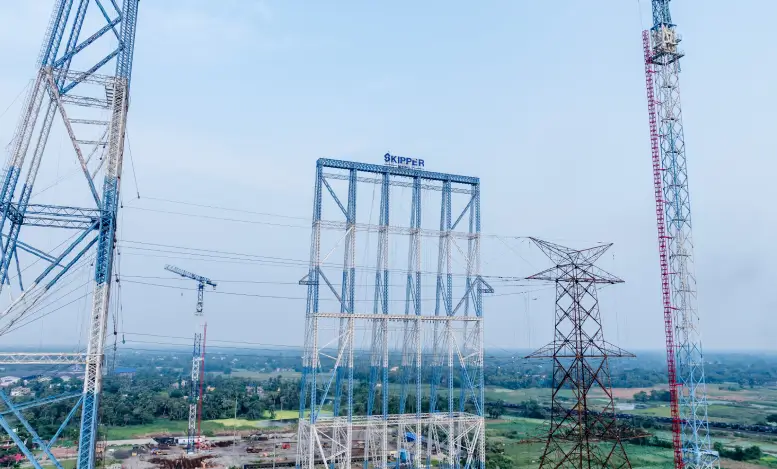
This is when a seasoned manufacturer can come in handy. Skipper also has high mast poles in its engineering portfolio and these are integrated through its production infrastructure. The range includes high masts from 10 to 60 m, with applications including parking and railroad yards, stations, metropolitan areas, airports, parks and stadiums.
This enables Skipper to provide more comprehensive engineered solutions to large-area lighting projects rather than just supplying a steel mast.


One of the world's largest integrated Transmission Tower manufacturing companies

The company is also engaged in EPC Projects in Power Transmission & Distribution, Telecom infra and Railway Structures
Skipper Limited is a national powerhouse in the Polymer Pipe business.


3A, Loudon Street, Kolkata- 700017, India